
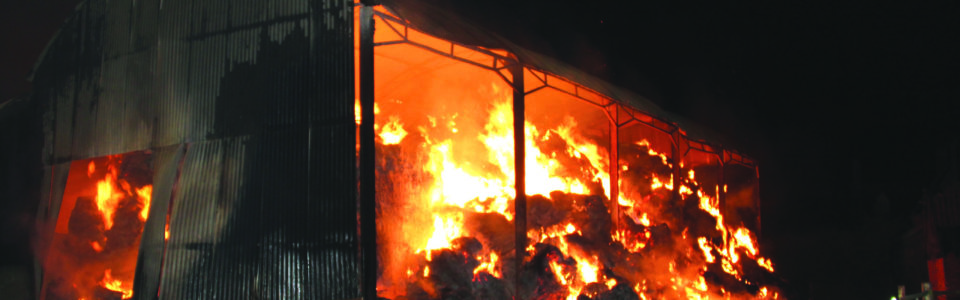
Fires at agricultural businesses present many challenges – the location is often remote, which means it will take a little longer for fire crews to arrive.
Straw/hay is very flammable, and there are often pieces of machinery and other items which carry a fire risk. Isolated premises are often targeted by arsonists, and water supplies can sometime be limited.
By reviewing your business, you can reduce your risk of fire. There are things you have to do by law, and there are extra things that will make it easier for firefighters to try and save your property.
To comply with the law
- Do a risk assessment and carry out any works identified.
- Manage your hazardous materials properly, ie storage, signage, fire protection.
- Ensure that people are alerted to a fire and can escape to a place of safety.
- Make a plan for evacuating your animals.
What you can do to help the fire service
- Display your property sign clearly at the entrance to enable emergency vehicles to find you quickly.
- Find out where your nearest fire hydrant is and keep it clear from overgrown vegetation.
- Make sure that other water supplies, such as ponds, lakes and pools, are readily available for firefighters to take water from.
- Think whether fire engines can reach all of your property. Fire appliances may be larger and heavier than your normal traffic – for example, will cattle grids support the weight of our vehicles?
- Cut back trees to allow good access.
Livestock evacuation
It is too late to plan for evacuating your livestock when a fire starts. You must consider how your livestock can be removed from a building, remembering that conditions may be dark, smoky, hot and noisy.
- Herd animals like to be where they feel safe, and many animals have been known to try and return to their pen or stable during a fire. This is highly dangerous for both them and firefighters. Therefore you must have a refuge in mind where they can be easily taken to and secured, out of harm’s way.
- Think about which way your gates are hung. They should open in the direction of travel to avoid animals bunching up and becoming jammed.
- All livestock should be evacuated upwind if at all possible.
- As part of your risk assessment, you should consider what type of animals you have and whether they need to be separated. A distressed bull, for instance, will be a highly dangerous proposition to move and therefore you might consider housing him in a secure pen, away from any danger, to avoid moving him at all.
Firefighting measures
You must dial 999 and ask for the Fire and Rescue Service as quickly as possible if a fire starts. However, it is important that you have some way of extinguishing a small fire if you are trained and it is safe to do so.
Part of your risk assessment will take account of how to prepare when carrying out welding, grinding or cutting, for instance. Creating a clean surface to work on, away from flammable materials and with the right safety measures in place, will hopefully prevent a problem. But if a spark causes a small fire, having a fire extinguisher or hose laid out ready will enable you to extinguish or slow the fire enough to save your property or protect yourself and the animals.
Different materials will require a different type of fire extinguisher; for example, you shouldn’t use water on an electrical fire because you will be electrocuted. The firefighting device must also be positioned somewhere easily accessible, not hidden at the back of the shed or in the loft.
Staff training
- You are responsible for making your staff aware of what to do in the event of a fire. Your main priority is their safety, but their swift actions may save animals or property.
- If you have fire extinguishers, fire blankets and/or hoses, your staff should be trained how to use them and know when to stop and let the professionals take over.
- Do not use anyone inexperienced for evacuating livestock – give them other meaningful tasks, such as telephoning the fire service and guiding crews onto site.
- Ensure that all staff know where the nearest telephone is and display accurate address details next to the phone. This may save valuable minutes as firefighters search for your property.
- Ensure that all staff are aware of the animal evacuation plan and places of refuge.
Accommodation other than your private domestic dwelling
You are responsible for fire safety under the law if you:
- Provide bed & breakfast accommodation in your house or other buildings;
- Have holiday accommodation, i.e. chalet, caravan, flat, campsite;
- Provide ‘live in’ worker accommodation on site as part of their employment (but not including tied accommodation such as separate flats, annexes, houses or apartments).
In these circumstances, you should seek further advice as you will need to ensure adequate ways of detecting a fire, alerting people, providing emergency lighting, signs and escape routes.
Find more information on our Farm Fire Safety Leaflet.