


Being outside and enjoying the water is great for both physical and mental health and well-being; however, we need to respect the water and know what to do if things go wrong.
Knowing what to do if you are struggling in water, if someone else is in trouble in the water, and how to stay safe is very important at all times of the year.
Please use the following information to find out how to stay safe and what to do if there is an emergency.
If you have children or teenagers, please share the advice with them to help them make positive choices to stay safe.
Remember the four main messages:
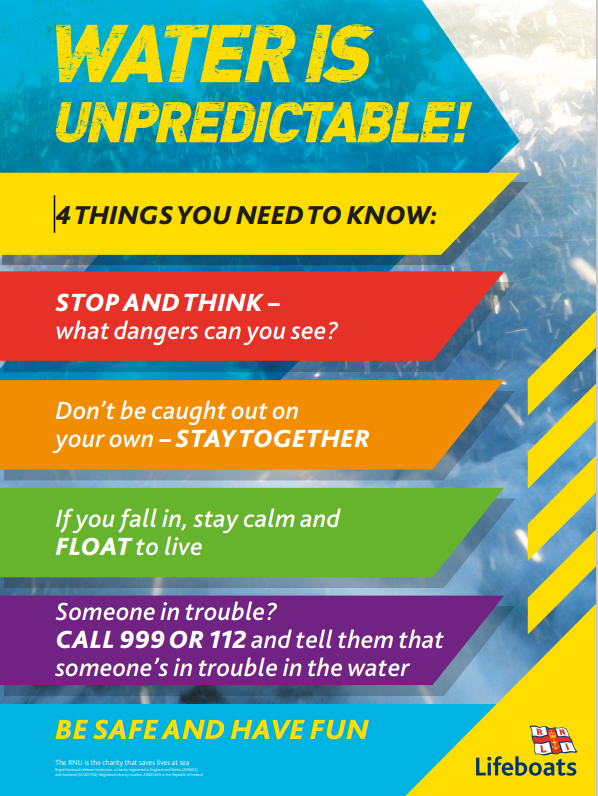
Find your float! What to do if you are struggling in water.
Knowing what to do if you are struggling in water is important, so you do not panic if you find yourself in difficulty.
How to float:
- Lie on your back with your head tilted back and your ears under the water
- Try to relax and breathe normally.
- Gently move your hands and legs to help you stay afloat if you need to.
- Spread your arms and legs out to improve stability – and it’s OK if your legs sink, we all float differently.
- Once your breathing is under control, call for help or swim to safety.
It is a good idea to practise floating in a supervised location like a swimming pool.
Please visit the RNLI website for more information Float To Live – What To Do In An Emergency – RNLI
Use this video to help you explain the importance to children RNLI Life Skills: teach your child how to float
Help! If someone is in trouble in the water:
Stay out of the water: Never go into the water yourself. You are putting yourself in danger and making it harder to rescue everyone.
What to do?
- Call 999 and ask for the fire and rescue service if inland, or the coastguard if by the sea.
- Tell them to float on their back
- Throw them something that floats for them to hold on to
Adults who feel confident and have something to use could try using the “reach rescue” technique Reaching Rescue if safe to do so, whilst waiting for the emergency services to arrive
Where are you?
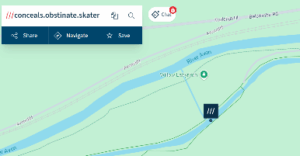
 Download What3words onto your mobile today.
It will give a reference of three words to show exactly where you are. Give this reference to the emergency services, and they will be able to locate you quickly.
Stay with them: If it is safe, stay with the person in the water and call to them from the bank. Encourage them to keep floating with their arms and legs out like a star.
Stay on the phone with the emergency service, explaining what is happening.
Useful information for the emergency services:
- What is the access to the area?
- What is the speed of the flow of the water?
- What is the casualty wearing?
- Are they a confident swimmer?
- Any hazards in the water?
Staying Safe
Going for a swim? Be aware of the risks:
- Never swim alone. Always swim with someone else or have someone on shore watching you.
- Look for safety information
- Do the conditions exceed your ability? Swimming in open water is very different to a swimming pool.
- Cold water shock: If you enter water suddenly, the cold water can cause your blood vessels to close, which causes your heart to work harder and make your blood pressure go up. It can also cause an involuntary gasp of breath and an increase in your breathing rate, which can cause panic and an increased chance of inhaling water. This can happen to anyone of any age or swimming ability. Cold Water Shock – Water Safety Tips – Know The Risks (rnli.org). Walk into the water, allowing yourself time to acclimatise to the temperature. Sponge to Plunge | Royal Life Saving Society UK ( RLSS UK )
- Currents and tides: Be aware of tides and currents, including rip currents, which can be hard to spot. Currents can occur in all bodies of water, including lakes and quarries as well as rivers and the sea. Tides Can Be Dangerous – Know the Risks – Beach Safety (rnli.org) Rip Currents – Water Safety Advice And Drowning Prevention (rnli.org)
- Underwater hazards: There may be unseen underwater hazards such as rocks, vegetation and rubbish.
- Other hazards: Avoid swimming near locks, weirs, deep water such as quarries, piers, breakwaters, harbours, boats etc.
- Alcohol: Never go into the water after drinking alcohol and take care when near water. Alcohol – Know the risks (rnli.org)
- Do not jump into unknown water. Jumping into water brings the risk of cold-water shock, underwater hazards not visible, unknown depth of the water and unknown currents.
- Be visible, for example, wear a bright swimming cap.
At the beach:
- Go to a lifeguarded beach
- Swim between the red and yellow flags
- Learn what the flags mean and follow the safety guidance RNLI Beach Safety – Know Your Flags And Signs
- Swim parallel to the beach and close to the shore.
- Avoid swimming near rocks, piers, breakwaters etc.
- Be aware that distances can be deceptive.
- Inflatables can be easily blown out to sea.
- If you are with children, make sure they know to stay with you.
Use this song to help young children remember how to be safe at the beach. – The RNLI’s Seaside Safety Song
Dogs and water

Many dogs love being in the water, but it is the owners responsibility to understand the dangers the dog may not be aware of.
Keep dogs on leads:
- near fast flowing or flooding rivers;
- where banks are steep or unstable;
- near cliffs.
Most dogs will manage to get out of the water, if your dog is struggling encourage them to swim to a part of the bank, they may find it easier to get out.
If your dog cannot get out, do not enter the water yourself as you could be putting yourself in danger.
Call 999 and ask for the Fire and Rescue Service (inland) or Coastguard (at the sea), the emergency services are trained and ready to rescue your dog.
Enjoy the water
There are many ways to enjoy the water apart from swimming such as fishing, walking near water, being on the water with SUPs, kayaks and boats. The RNLI has lots of safety advice for all users of the water Choose your activity – Safety advice (rnli.org)
Consider joining an open water swimming club for advice, guidance and company.
Consider signing up younger children for a “Swim Safe” session Swim Safe – Beach and Water Safety Sessions for Children (rnli.org)
Make sure that you are aware of where your children are at all times near water, that they are aware of the risks / what you say they can do and what you do not want them to do, and what to do in an emergency.