
Could you be a great fit for our Service?
This self-assessment will help you decide.
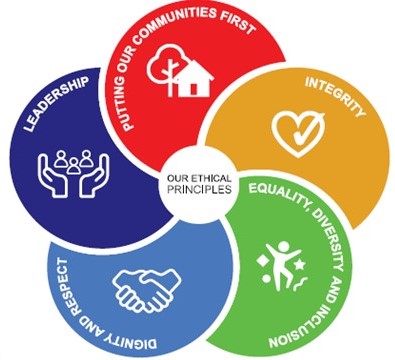
As a Service, we have embedded the Core Code of Ethics designed for all Fire and Rescue Services. The Core Code of Ethics sets out five ethical principles, which provide a basis for promoting good behaviour and challenging inappropriate behaviour.
This self-assessment demonstrates how the ethical principles and behaviours apply in common workplace situations, from helping a distressed member of the public to managing a complex financial scenario.
- There is no pass or fail — this exercise is about self-awareness.
- You will be presented with 14 short scenarios and two possible actions in each situation.
- For each scenario, select the action you would be most likely to take.
- Be as honest as possible to get the most benefit from this assessment.
- After making your selection, you will receive feedback about how it matches our Core Code of Ethics.
- There is no time limit but you should allow about 10 minutes.
Scenario 1
You arrive at your place of work and find a visitor waiting outside, tapping the door and looking into the building apparently searching for someone.
What might you do?
Scenario 2
A colleague asks you about the location of a piece of equipment that they need to use urgently. It’s something that everyone in the team needs to use regularly and you remember putting it away somewhere in a hurry the last time that you used it without preparing it ready for the next person’s use.
What might you do?
Scenario 3
During a break when you are sitting down with your team, someone tells a joke that you feel is inappropriate and, although you’re not offended personally, you know it might cause offence to someone from a particular group.
What might you do?
Scenario 4
A new person joins your team; they are trying hard to get on with everyone but they just don’t really seem “your type” and probably won’t ever really fit in with the group.
What might you do?
Scenario 5
You’re in a team meeting and one of your colleagues, who is usually easy-going at work, raises their voice, gets very angry about what’s being discussed, and then storms out of the room.
What might you do?
Scenario 6
After completing a piece of work with people from another team in the Service, one of that team asks to meet up to give you some feedback about how the work was delivered.
What might you do?
Scenario 7
You are approached outside your house on a Saturday morning by one of your elderly neighbours who you know lives alone. They know that you work for the Fire Service and they’re really unhappy about the smoke alarm that was fitted for them by the Service as it keeps beeping at them. They haven’t been able to sleep and want something done about it today.
What might you do?
Scenario 8
You’ve volunteered to represent the Service at a community safety event being run for a number of local service providers in your village hall. As you’re setting up the stand with Fire Service colleagues, you notice that the volunteers in the hall’s kitchen are raising voices at each other and seemingly distressed about something.
What might you do?
Scenario 9
You’re in the final stages of finishing a key piece of work on the day that it is due to be delivered when a colleague asks for your input on an urgent enquiry that they’re dealing with and that you both know will have major consequences if not dealt with immediately.
What might you do?
Scenario 10
You notice that one of your colleagues is increasingly frustrated with a monthly task that they have to perform – it involves gathering information from lots of other people, whom they always have to chase, distributing the data to another group and then spending time trying to get a response from them. You wonder if you can help.
What might you do?
Scenario 11
You’re asked by a manager to take on a certain piece of work that you’re really keen to get involved with. However, you already have a packed schedule and are not at all sure that you’ll achieve what’s required as well as meeting your other deadlines.
What might you do?
Scenario 12
You present some information to another team and, at the end of your presentation, you ask if anyone has any questions about what you’ve said. The response is a blank face from everyone around the table.
What might you do?
Scenario 13
You’re at your team meeting and your manager raises a complaint from another department that clearly shows that someone in your team has made a mistake at work. This could have resulted in a serious problem for the Service (although it didn’t on this occasion), and they want to make sure the same thing doesn’t happen again.
The manager says that they’ll talk to each of you individually throughout the day to try to establish what’s happened.
What might you do?
Scenario 14
You contact a department at headquarters to request something that you need in order to do your job effectively. They ask you to log your request through the computer system and then fill out a form with the full information behind your request. This feels like a waste of time when you have a job-based need.
What might you do?
Thank you for completing the Code of Ethics self-assessment.
We hope that going through these scenarios and reading the feedback provided has given you an insight into our culture and the way that we work.
Our values and behaviours are central to how we work in the Service and are part of the selection process for all vacancies.
We encourage you to review the Core Code of Ethics in more detail before you progress with your application to ensure that you fully understand what we look for when selecting candidates.
Good luck with your application!